Why 90% of Gold Traders Lose Money (And How Automation Fixes It)
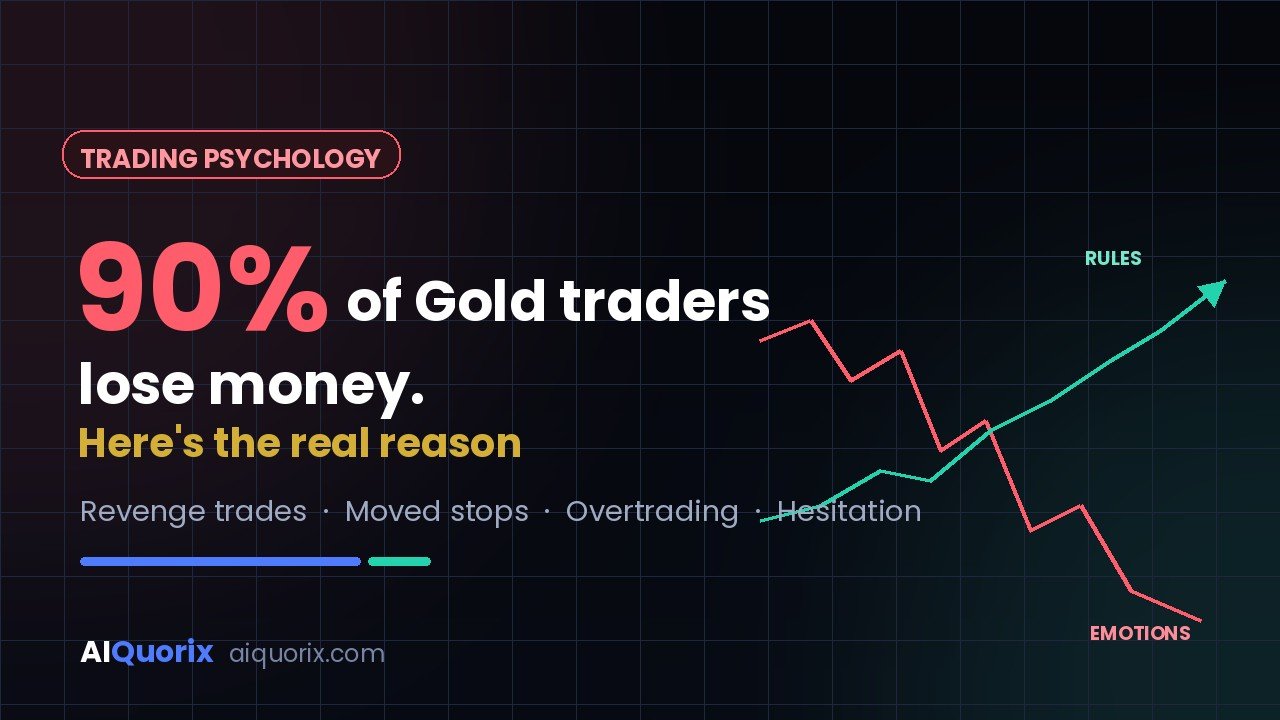
It's rarely the strategy that blows the account — it's the human holding it. Here are the real reasons most Gold traders lose, and what changes when you take emotion out of the equation.
Ask ten losing traders what went wrong and you will hear ten versions of the same story. The strategy worked for weeks. Then one bad day undid all of it. A doubled position here, a removed stop loss there, and an account that took months to build was gone in an afternoon.
The uncomfortable truth is that most traders don't lose because their strategy is bad. They lose because they can't follow it.
The statistics nobody frames on their wall
Broker disclosures across the industry tell the same story: somewhere between 70 and 90 percent of retail accounts lose money. Gold traders may have it worst of all, because XAUUSD is fast, leveraged, and brutally punishing to hesitation. The same volatility that makes Gold attractive is what empties accounts.
But here's the detail worth sitting with. When researchers dig into why accounts fail, the top reasons are almost never technical. They are behavioral.
The four ways traders beat themselves
Revenge trading
You take a loss. It stings. Instead of walking away, you jump straight back in — bigger size this time, because you're not trying to trade anymore, you're trying to get your money back. Gold's sharp moves make this especially seductive and especially fatal. One loss becomes three, and the third one is double size.
Moving the stop loss
The trade goes against you. Your stop is ten pips away. Suddenly your brain produces a very convincing argument for why the market will "definitely turn around" if you just give it a little more room. So you drag the stop. Then you drag it again. A planned small loss becomes the biggest loss of your month.
Overtrading
The market owes you nothing on a quiet day, but after staring at charts for three hours, your brain starts inventing setups just to feel useful. Forced trades in dead markets are a slow leak that sinks accounts quietly, one mediocre entry at a time.
Fear at exactly the wrong moment
The cruelest one. A genuinely good setup appears — the kind you wait all week for — but you just took two losses, so you hesitate. The trade runs without you, in your direction, hitting every target. Then, frustrated at missing it, you chase the next mediocre signal. Fear made you skip the winner and take the loser.
Notice something? Every single one of these failures happens after the analysis is done. The chart reading was fine. The human was the problem.
A strategy is only as good as your worst emotional day.
What discipline actually costs
People say the fix is discipline, and they're not wrong — they're just underestimating what discipline means in practice. It means executing the same rules at 9 a.m. and 3 a.m. It means taking the fifth valid setup with the same calm as the first, even after four losses. It means sitting on your hands for six hours because no setup exists, then acting instantly when one does.
No trader does this perfectly. Not you, not us, not the professionals. Humans are not built for it. Institutions figured this out decades ago — which is why the majority of institutional order flow today is executed by algorithms, not by a person clicking a mouse.
What changes when software executes the plan
An automated system like an Expert Advisor does not fix a bad strategy. What it fixes is everything else:
- It never revenge trades. After a loss it simply waits for the next valid setup, exactly as the rules say.
- It never moves a stop loss out of hope. Risk is defined before entry and stays defined.
- It never forces a trade out of boredom. No setup, no trade — for six hours or six days.
- It never hesitates. When conditions line up at 3 a.m., it executes at 3 a.m.
- It sizes every position by the rules, not by how confident it feels after a winning streak.
In other words, automation takes the four account-killers off the table completely. What's left is just the strategy — win or lose on its own merits, executed the same way every single time.
Where Raees Concept EA fits in
We built Raees Concept EA around Smart Money Concepts — order blocks, fair value gaps, and market structure shifts on the Gold 15-minute chart. If you've read our guides on those, you know the logic. The EA simply executes that logic with the one thing no human trader has: perfect consistency.
Risk per trade is fixed as a percentage of your balance. Stops go beyond the structure, not at a random distance. Targets sit at the next liquidity zone, and a trailing stop protects profits when a trade runs. You can pause it any time from your dashboard — even from your phone — and open trades still close at their own stop or target.
We'll say plainly what the marketing pages of this industry won't: no bot wins every trade, and anyone promising guaranteed profits is lying to you. What automation offers is different — it guarantees your plan gets followed. For most traders, that alone is the difference between the 90 percent and the rest.
Start on a demo account, watch how it behaves for a couple of weeks, and compare that consistency to your own trading history. That comparison usually says everything.
Trading involves substantial risk. Only trade with capital you can afford to lose. Past performance does not guarantee future results.