Backtest vs Live Trading: Why Results Differ (Slippage, Spread & News)
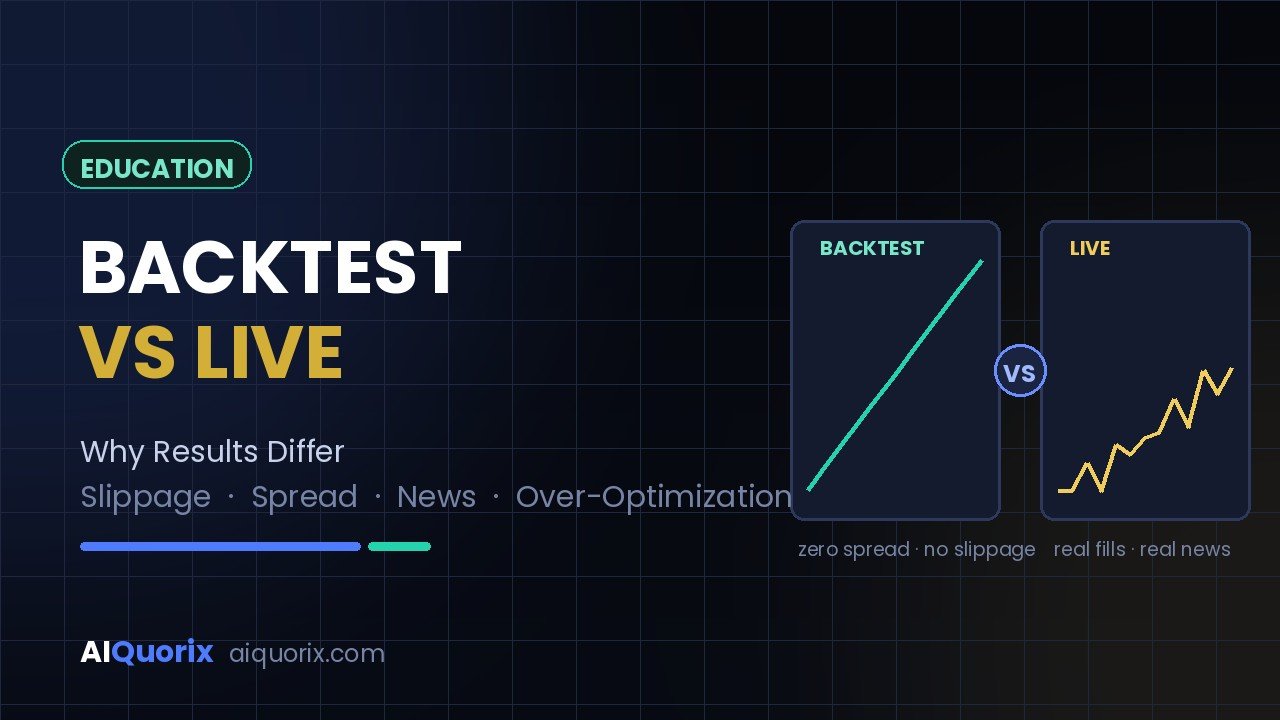
Your backtest looks perfect. Your live results look... different. That gap has real, explainable causes — spread, slippage, news and over-optimization. Here's what's actually going on.
Somewhere right now, a trader is staring at a beautiful backtest — a smooth green curve climbing for two years without a care in the world — and wondering why their live account doesn't look anything like it.
We're going to answer that honestly, because this industry mostly doesn't. Backtests and live trading differ for specific, mechanical reasons. None of them are mysterious, most of them are measurable, and knowing them will make you immune to the prettiest scam in forex: the flawless equity curve screenshot.
Reason 1: The spread you tested isn't the spread you trade
Most backtests run on a fixed spread — say, 20 points on Gold, all day, every day. Real Gold spreads breathe. They're tight during London and New York overlap, wider in the Asian session, and they can explode to five or ten times normal for a few seconds around news or at the daily rollover.
Your strategy pays the spread on every single trade. If the backtest assumed the best spread of the day while your live trades sometimes fill during the worst, the difference compounds over hundreds of trades. It's rarely dramatic on any one position — it's a steady tax the backtest never charged you.
Reason 2: Slippage doesn't exist in a backtest
In a simulation, when your entry level is touched, you get filled at that exact price. Every time. Perfectly.
Live markets don't work like that. Between the moment your order is sent and the moment it fills, price moves. On a calm chart the slip might be zero. When Gold is running — which is exactly when SMC setups trigger, because they fire on structure breaks — the market can jump several points before your fill lands. Sometimes slippage even helps you, but on entries taken during momentum, it usually costs a little. Backtests are a world with zero latency; live trading never is.
Reason 3: News candles are simplified history
A backtest sees a news spike as one clean historical candle and calculates your fill inside it politely. Reality during a big release is uglier: spreads blown wide, prices gapping in steps, brokers rejecting or requoting orders for a few seconds. A stop loss inside a news gap fills where the market lands, not where you drew the line. History files smooth all of this away — live accounts experience it raw.
Reason 4: The quiet killer — over-optimization
This one isn't about brokers at all. It's about us, the humans testing.
Run enough setting combinations and you will eventually find one that fits the past like a tailored suit — every winner caught, every loser avoided. The problem is you didn't discover the market's logic; you memorized history's answer key. The future hasn't read the key. That's why obsessively tuned backtests often collapse live: they were optimized for a past that won't repeat exactly.
A backtest tells you a strategy COULD work. Only live conditions tell you it DOES.
This is why we're deliberately conservative with tuning. A strategy with sane, structural logic that performs decently across different periods beats a "perfect" curve fitted to one lucky year.
So are backtests useless? No — here's what they're for
After all that, we still backtest everything, and you should too. Used honestly, a backtest answers real questions: Does the core logic have an edge at all? How deep do the losing streaks go? What drawdown should I emotionally prepare for? How does it behave in trending months versus choppy ones?
What a backtest cannot do is promise you a number. Treat it as a stress test, not a forecast.
To make yours as honest as possible: test with real tick data and variable spreads if your MT5 setup allows it, add a little assumed slippage, and never trust results from a period you specifically tuned for. Then do the one thing that closes the gap best of all — forward testing.
The bridge between the two worlds: demo forward testing
A demo account is a live market with fake money. Real spreads widening at rollover, real news candles, real fills at real speed — everything a backtest hides, without risking a rupee. That's why our advice for Raees Concept EA has never changed: run it on demo first, for at least a couple of weeks, and watch how it behaves in current conditions.
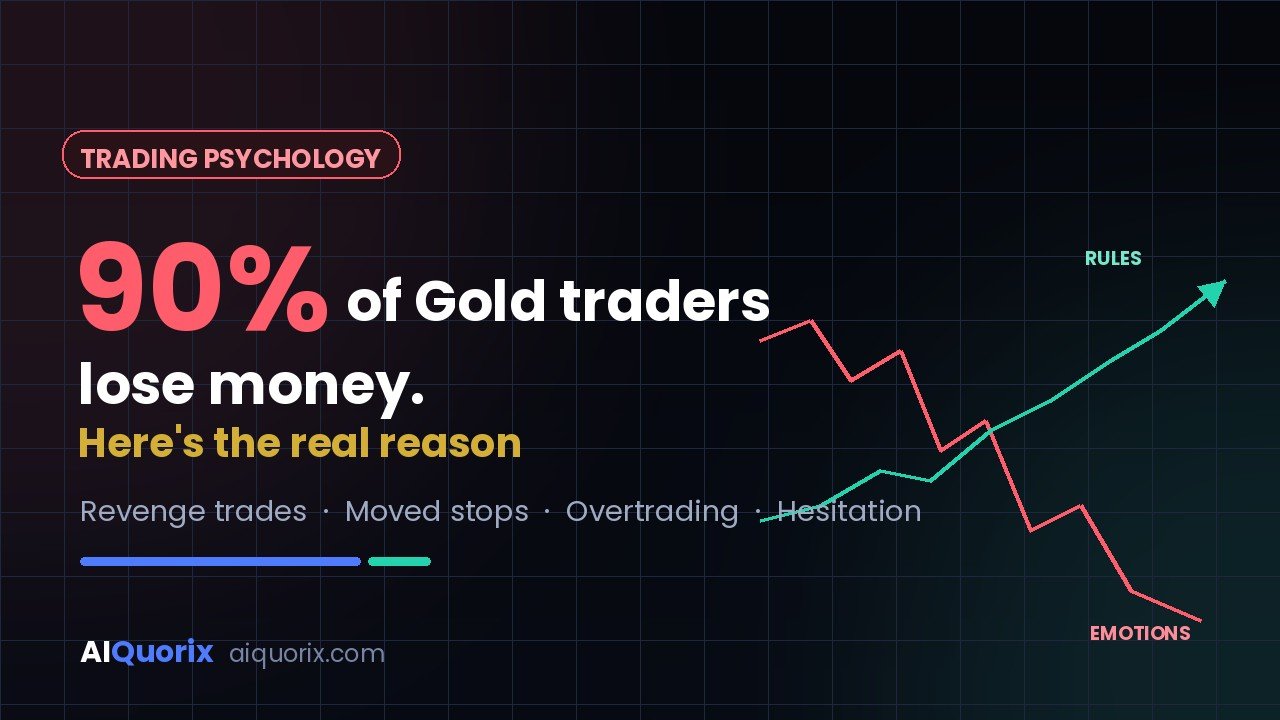
One thing our EA does NOT suffer from, in backtest or live, is the biggest gap most manual traders discover: their own psychology. A human backtests with calm hindsight and trades live with a racing heart — skipping valid setups, closing winners early. The EA executes identically in both worlds. For automated trading, the backtest-vs-live gap is only the mechanical stuff above — the emotional gap is gone entirely. We wrote about why that matters more than most people think in our post on why 90% of Gold traders lose money.
The honest summary
Expect your live results to be somewhat below your backtest. Not because anything is broken — because live markets charge fees that history doesn't: spread variation, slippage, news chaos. A good strategy survives those costs with its edge intact. A curve-fitted fantasy doesn't.
Anyone showing you a perfect backtest as proof of future profit is selling you the past. We'd rather show you the logic, hand you a demo, and let the live market make the argument.
Trading involves substantial risk. Only trade with capital you can afford to lose. Past performance does not guarantee future results.