What Is a Market Structure Shift (MSS)? The Signal Smart Money Leaves Behind
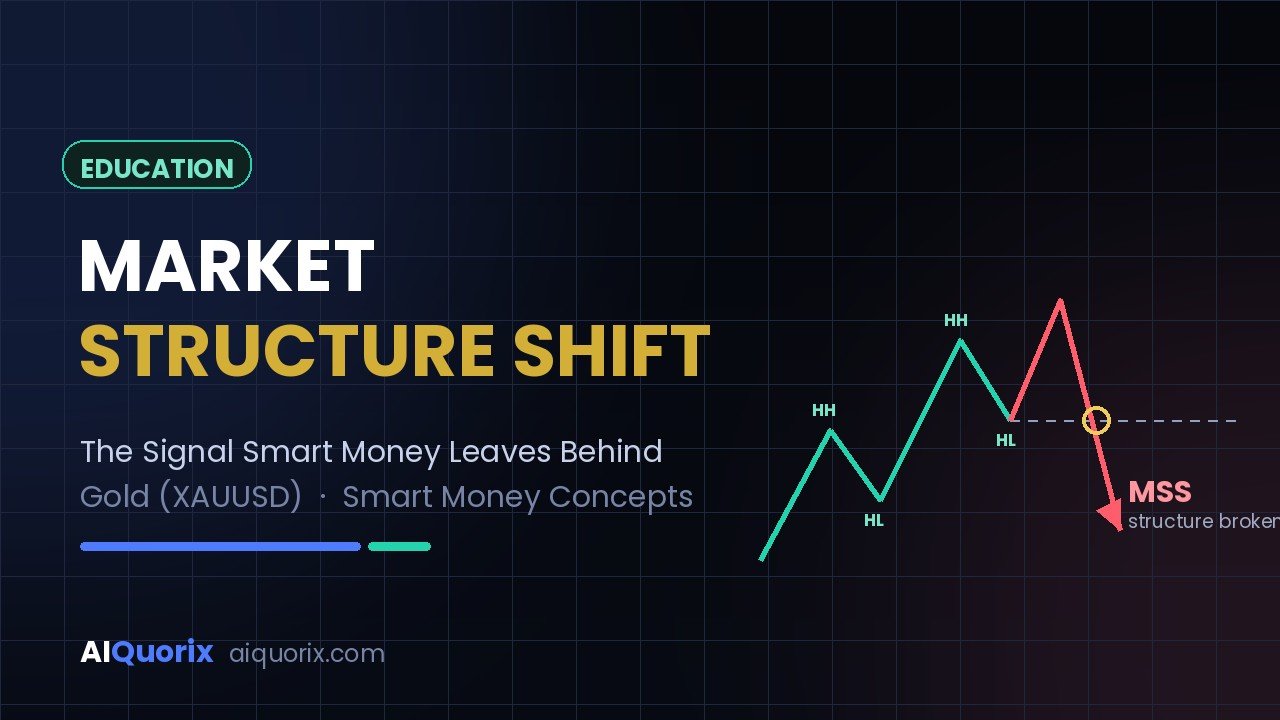
Trends don't end quietly — they leave a fingerprint. Learn what a market structure shift is, how it differs from a break of structure, and how to spot the moment a Gold trend actually turns.
Every trader has lived this nightmare: the trend looks strong, you buy the dip like the last three times, and this dip just... keeps dipping. The trend was over and the chart knew it before you did.
Here's the thing — the chart really did know. Trends almost never end silently. They leave a specific, readable fingerprint at the turn, and that fingerprint is called a market structure shift. Learn to read it, and you stop being the person who buys the top.
First, what market structure actually is
Strip away the indicators and every trend is just a pattern of swings.
- An uptrend makes higher highs and higher lows. Each rally pushes further, each pullback stays shallower.
- A downtrend makes lower highs and lower lows. Each drop goes deeper, each bounce gets weaker.
That's it. That's market structure. As long as Gold keeps printing higher highs and higher lows, the uptrend is alive, whatever your RSI says. Structure is the market's honest diary — price can't fake where it actually swung.
The moment everything changes
Now imagine Gold in a clean uptrend. Higher high, higher low, higher high. Then a pullback comes and instead of holding above the last higher low, price slices straight through it and closes below.
That close is the event. The pattern of the entire trend just failed for the first time. Buyers who defended every previous dip either stepped away or got overwhelmed. This is a market structure shift — the earliest structural evidence that a trend is turning.
Why does it matter so much in Smart Money Concepts? Because institutions can't turn a market quietly. Reversing billions in positioning forces price through the very swing levels the old trend depended on. The MSS is the visible scar that turn leaves behind. Retail sees a scary red candle; a structure trader sees a signal.
MSS vs BOS — they are not the same thing
These two get mixed up constantly, so here is the clean distinction:
- A break of structure (BOS) happens in the direction of the existing trend. Price takes out the previous higher high in an uptrend. It's a continuation signal — the trend flexing.
- A market structure shift (MSS) happens against the trend. Price takes out the previous higher low in an uptrend, or the previous lower high in a downtrend. It's a potential reversal signal — the trend cracking.
Same mechanic, opposite meaning. BOS says "keep going." MSS says "everything you assumed just changed."
How to spot an MSS on the Gold chart
On XAUUSD M15, the process is simple enough to do by eye:
- Mark the recent swing highs and swing lows — the obvious turning points, not every tiny wiggle.
- Identify the pattern: is Gold making higher highs and higher lows, or lower highs and lower lows?
- Watch the level that guards the trend — the most recent higher low (in an uptrend) or lower high (in a downtrend).
- Wait for a candle to close beyond that level. A close, not a wick.
That last word carries all the weight. Gold is famous for stabbing through a swing level with a long wick, grabbing the stop losses resting there, and snapping back into the trend. That's a liquidity sweep, not a shift. If you've read our order blocks guide, you already know why those pools of stops attract price. A wick through the level means nothing; a body closing beyond it means everything.
What smart money does right after the shift
Here's where it gets useful. An MSS on its own tells you the trend changed — it doesn't yet give you a trade. Chasing the breakout candle usually means entering at the worst price of the day.
Watch what happens instead. After the shift, price very often pulls back — right into the order block where the reversal was born, or into the fair value gap the breakout candle left behind. That retest is the entry smart money concepts traders wait for: a new trend, confirmed by structure, offering a second chance at a fair price with a logical stop loss behind it.
The MSS is the announcement. The retest is the invitation.
That sequence — shift, pullback, retest, continuation — is the backbone of the entire SMC approach.
The honest caveats
No signal works every time, and MSS has two failure modes worth knowing. In choppy, rangebound markets, structure "shifts" constantly in both directions — those shifts mean nothing because there's no real trend to reverse. And even in trending markets, a shift can turn out to be a deep pullback rather than a full reversal. This is why context and confluence matter: an MSS that lines up with a fresh order block and a fair value gap is a different animal from a lone break in the middle of chop.
How Raees Concept EA uses MSS
If you've followed our education series, you can now see the full machine. Raees Concept EA watches Gold M15 structure continuously and uses MSS and BOS as its permission system: no confirmed shift or break, no trade — no matter how tempting a zone looks. When structure does confirm, it waits for the retest of the order block or fair value gap, enters with the stop beyond the zone, targets the next liquidity level, and trails the rest.
Everything you just learned to see by eye, it monitors every minute of every session — including the sessions you sleep through. If you want to watch it read structure in real time, run it on a demo account for a week. The chart comments show you exactly what it's waiting for and why.
Trading involves substantial risk. Only trade with capital you can afford to lose. Past performance does not guarantee future results.