Manual Trading vs Trading Bots: An Honest Comparison
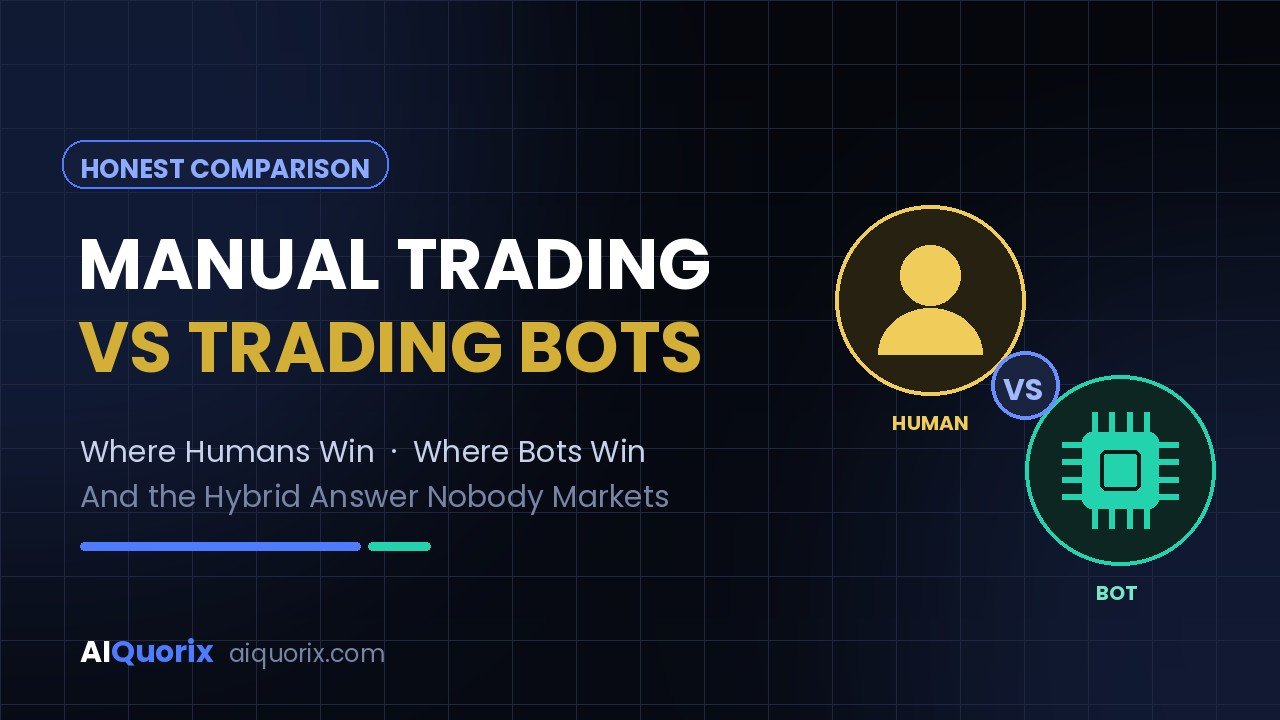
Bot sellers say automation wins. Trading gurus say nothing beats a human. Both are selling you something — here's the comparison neither side gives you straight.
Let's get something out of the way first: we sell a trading bot. You should know that while reading this, because almost everyone who writes about this topic is selling one side of it. The gurus selling courses will tell you bots are scams. The bot sellers will tell you manual trading is obsolete. The truth is less convenient for both.
So here's the comparison we'd want to read if we were you — including the parts where the human wins.
Where the human wins
Let's start with what a good manual trader does that no bot can.
Context. A human knows the central bank meeting is in an hour. They know this week's rally is driven by a war headline that could reverse on one statement. A bot sees candles; an experienced human reads the room around the candles. That situational awareness is real edge, and automation simply doesn't have it.
Adaptability. Markets change character. A discretionary trader senses when a strategy is drifting out of sync with conditions and adjusts in real time. A bot follows its rules off a cliff if the rules stop fitting — that's why every serious EA needs a human deciding when it runs.
The exceptional trade. The best trades of a manual trader's year often come from pattern recognition too subtle to code — a confluence of things they've seen a thousand times. Software executes rules; it doesn't have intuition built from a decade of screen time.
There's just one problem with all of this: it describes a disciplined, experienced trader. And that brings us to the other column.
Where the bot wins
Consistency, every single time. The bot takes the fifth setup after four losses with exactly the same calm as the first. No human does. We wrote an entire post on why 90% of Gold traders lose money, and the short version is: not the strategy — the execution under emotion. The bot deletes that entire failure category. No revenge trades, no moved stops, no hesitation, no boredom entries.
Time. A manual SMC trader watching Gold M15 for order block retests is doing a full-time job. The bot does that job around the clock, including the 3 a.m. sessions where some of the cleanest setups form, while you keep your actual life.
Speed and math. Position sizing calculated from live balance and stop distance on every trade, entries fired the moment conditions confirm — no calculator, no second-guessing, no fat-finger errors.
Testability. You can run a bot's exact logic over years of history and forward-test it on demo. A discretionary trader can't backtest their gut. With a bot, at least you know precisely what you're getting — the rules never quietly change based on mood.
The honest scoreboard
Look at the two lists again and notice something. The human's advantages require years of experience, deep discipline, and constant screen time. The bot's advantages require... turning it on.
That's the real asymmetry. A world-class discretionary trader probably beats any retail bot. But almost nobody buying their first Gold strategy is a world-class discretionary trader — they're a person with a job, a family, and two hours of evening screen time, competing against institutions. For that person, the comparison isn't "bot vs expert human." It's "bot vs tired human trading on emotion after work." That second matchup isn't close.
The question isn't whether a bot beats the best trader alive. It's whether it beats the trader you actually have time to be.
The hybrid answer nobody markets
Here's where we land, and it's neither extreme. The best setup for most people is automation doing the execution and a human doing the supervision.
The bot handles what humans are bad at: watching structure all night, sizing positions by math, taking every valid setup identically. You handle what bots are bad at: context. Big news week coming? Market conditions feel wrong? That's your call to make — and with Raees Concept EA it's a one-tap call, because you can pause new trades from your dashboard or phone anytime and resume when things settle. Open trades keep their stop and target; nothing is abandoned.
That division of labor — machine executes, human governs — is roughly how institutional desks run their own algorithms. There's no reason retail should do it differently.
How to decide for yourself
If you have years of experience, iron discipline, and hours of daily screen time, manual trading may genuinely serve you — respect for anyone who does it well. If you're everyone else, the honest path is: pick a bot whose logic you can actually understand (our order blocks, fair value gap and market structure guides explain ours completely), run it on demo for two weeks, compare its consistency against your own trading history, and keep your finger on the pause button for the weeks you'd rather sit out.
No hype needed. The comparison, run fairly, makes its own argument.
Trading involves substantial risk. Only trade with capital you can afford to lose. Past performance does not guarantee future results.