Risk Management for Small Accounts: Trading Gold with $100
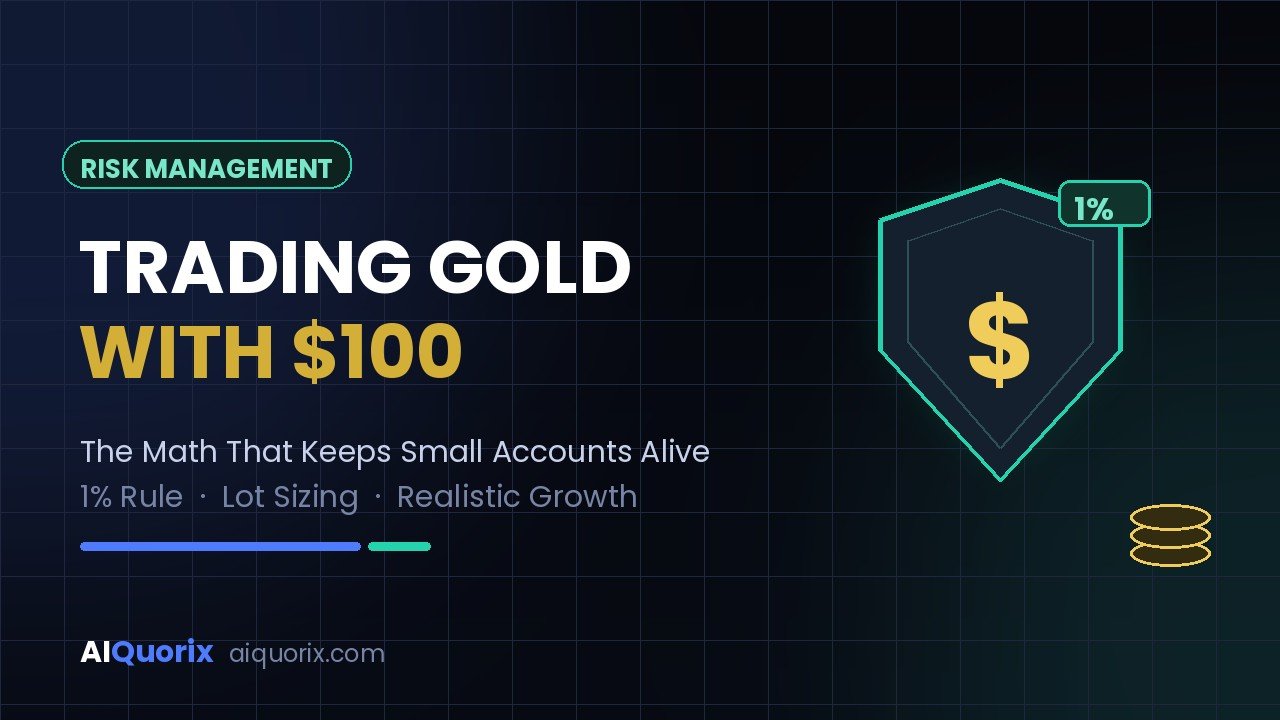
A $100 account isn't too small to trade — it's too small to trade carelessly. Here's the exact math that keeps small Gold accounts alive, and the settings that put it into practice.
Let's talk about the account nobody makes YouTube videos about: the $100 account. Not the funded challenge, not the six-figure flex — the real account most traders actually start with.
Here's the truth upfront. A $100 account can absolutely grow. But almost everyone who blows one doesn't lose it to the market — they lose it to their own position sizing in the first two weeks. Small accounts don't die of bad luck. They die of oversize.
The math nobody wants to do
Risk management sounds boring until you see what it's actually protecting you from. This table lives rent-free in every professional trader's head:
- Lose 10% of your account, and you need 11% profit just to get back to zero.
- Lose 25%, and you need 33% back.
- Lose 50%, and you need to DOUBLE your money just to break even.
- Lose 70%, and you need 233%.
Read that last one again. The hole gets exponentially deeper than the fall. This is why one oversized trade is never "just one trade" — it changes the entire math of your recovery. Protecting the downside isn't cautious advice for beginners; it's the actual game.
The 1% rule, in real dollars
The classic rule says risk no more than 1% of your balance on any single trade. On $100, that means one dollar per trade.
One dollar. Sounds almost insulting, right? Now look at what it buys you. Risking 1% per trade, you could take twenty losses in a row — twenty! — and still have over 80% of your account intact and fighting. Risking 10% per trade, seven straight losses cut your account nearly in half, and Gold can hand you seven losses in a bad week without blinking.
The 1% rule isn't about any single trade. It's about guaranteeing you're still in the game when the good run comes. Every strategy on earth, including ours, has losing streaks. Risk management is what decides whether you survive them.
What this means for lot size on Gold
Gold moves fast — a normal M15 stop loss on XAUUSD might be a few dollars of price range. With proper math, your position size is calculated from two things: how much you're risking (1% of balance) and how far your stop is. Bigger stop, smaller lots. Tighter stop, slightly bigger lots. The risk stays constant.
Doing this by hand for every trade is where most people give up and just pick a "feels right" lot size. That feeling is precisely the bug. On a $100 account, a 0.1 lot Gold position moved just a dollar of price against you is a 10% account hit — one impulsive click and your recovery math changes for the month.
The realistic expectations paragraph
Here's the part most sellers won't write. A $100 account growing at a genuinely excellent pace — say a few percent a month with controlled risk — makes you a few dollars a month at first. If that sounds disappointing, remember two things.
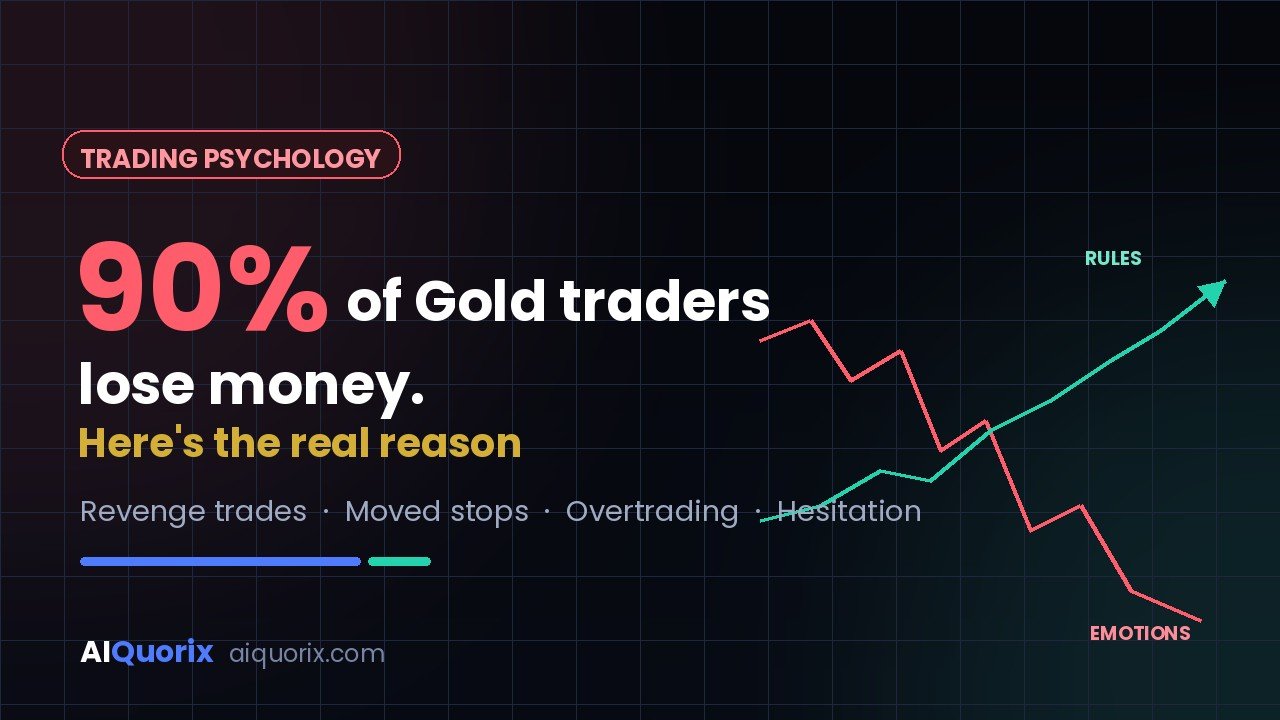
First, percentage is the only number that matters. A trader who can compound a small account carefully has the exact skill that scales to a large one — deposit more later and the same math prints bigger numbers. Second, the alternative isn't faster growth. The alternative, statistically, is zero. We wrote a whole post on why 90% of Gold traders lose money, and oversizing small accounts is a leading cause. Slow is not the price you pay — slow is the strategy.
Small accounts don't need bigger wins. They need longer lives.
How to set this up in Raees Concept EA
This entire post is already built into the EA's inputs. For a $100 account, our recommended settings are:
- Risk per trade: 1.0 — the EA calculates the lot size for every single trade from your live balance and the stop distance. Balance grows, size grows. Balance dips, size shrinks automatically. No emotions, no mental math at 2 a.m.
- Max lot size: 0.1 — a hard safety ceiling. Even if a tight stop makes the formula suggest more, the EA will never exceed this. For balances under $100, set it lower.
- Stops go beyond the order block or fair value gap — a structural level, not a random pip count — and targets sit at the next liquidity zone.
The result is that every trade, win or lose, costs or earns roughly what it should. A losing week is an inconvenience instead of a funeral. And because sizing is automated, the classic small-account killer — doubling up after a loss — simply cannot happen.
One more habit worth building: if news weeks or wild conditions make you nervous, you can pause the EA from your dashboard or phone anytime. New trades stop, open trades keep their stop and target. Risk management isn't only position size — sometimes it's knowing when to sit out, and that button makes it a one-tap decision.
Start here
If you're beginning with $100, do it in this order: run the EA on a demo account first, watch it size positions for a week or two, then go live with the settings above. Our setup guide covers every input in ten minutes.
Grow the percentage, not the ego. The dollars follow.
Trading involves substantial risk. Only trade with capital you can afford to lose. Past performance does not guarantee future results.