Liquidity Grabs & Stop Hunts: Why Price Hits Your Stop Then Reverses
Ever had your stop loss hit right before price reversed? Learn how liquidity grabs and stop hunts work on gold (XAUUSD), where liquidity sits, and how to stop being the exit liquidity.
It is one of the most frustrating experiences in trading. You enter a great setup, place your stop loss just below a clear swing low, and then — as if the market can see your order — price spikes down, takes your stop, and immediately rockets in your original direction without you. This is not paranoia or bad luck. It is a liquidity grab, and once you understand it, gold's behaviour starts to make sense.
What Is Liquidity, Really?
In trading, "liquidity" simply means resting orders — places where a large number of buy or sell orders are waiting to be filled. The market is drawn toward liquidity because big participants need it to fill their positions. You cannot buy 500 lots of gold if there is nobody to sell to; you need a pool of sell orders. So price naturally gravitates toward areas where lots of orders are stacked.
The two richest sources of liquidity are:
- Stop losses. Retail traders cluster their stops in obvious places — just beyond swing highs and lows, round numbers, and trendlines.
- Pending orders. Breakout traders place buy stops above resistance and sell stops below support.
To the institution, your stop loss is not just a risk-management tool. It is fuel.
Where Liquidity Sits on the Chart
You can predict liquidity pools with surprising accuracy because retail behaviour is predictable. Look for these areas:
- Equal highs and equal lows. When price forms two or more highs at almost the same level, a wall of stop and breakout orders builds just above them. The same applies to equal lows.
- Obvious swing points. A clean, well-respected swing high or low is a magnet.
- Round psychological numbers. On gold, levels like 2400.00 or 2350.00 attract clustered orders.
- Trendline touches. Everyone draws the same trendline, so everyone places orders in the same zone.
If you can see the liquidity, so can smart money — and so can a well-programmed algorithm.
Anatomy of a Stop Hunt
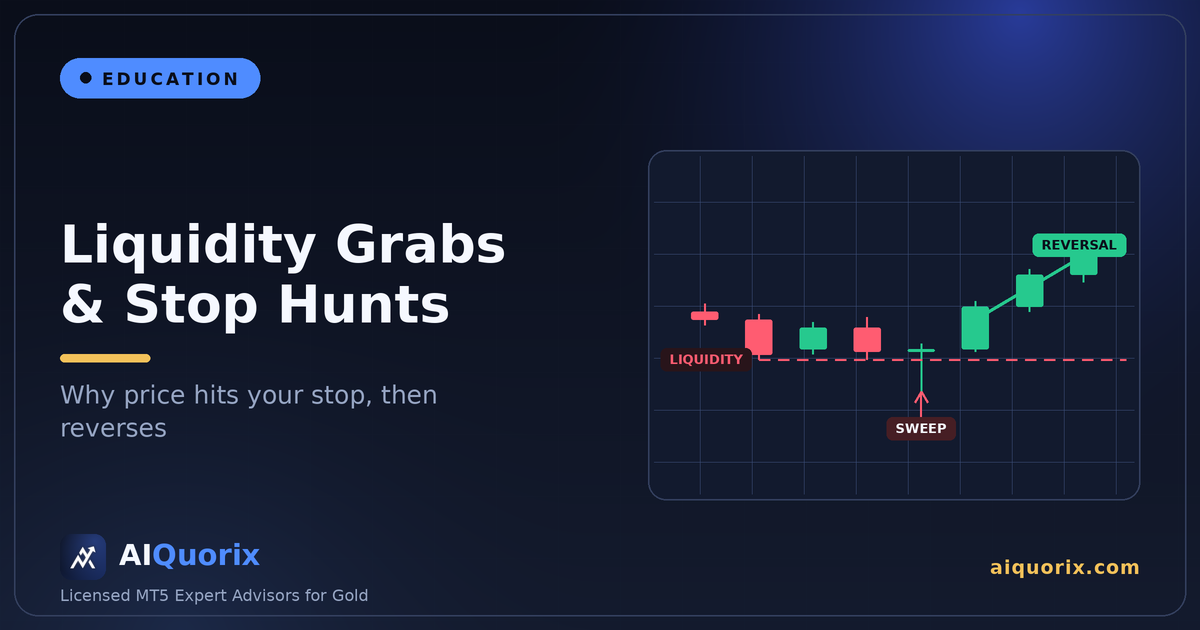
A textbook stop hunt (also called a liquidity sweep) unfolds in three phases:
- The build-up. Price forms an obvious level — say, a double bottom. Retail traders go long and tuck their stops just beneath it. Sell-side liquidity accumulates below.
- The sweep. Price pushes sharply below the level, triggering all those stops. Those stop losses become market sell orders — which is exactly the liquidity institutions use to fill their large buy positions at a great price.
- The reversal. With their orders filled, smart money lets price snap back. The move you originally expected finally happens, just without the traders who got stopped out.
The tell-tale sign is a long wick that pierces a key level and closes back inside. That wick is the footprint of the grab.
How to Stop Being Exit Liquidity
You cannot stop liquidity grabs from happening — they are a structural feature of the market. But you can stop being the one who gets hunted.
- Place stops with logic, not habit. If everyone puts their stop 5 pips below the swing low, that is precisely where the sweep will reach. Give your stop room beyond the obvious liquidity pool, or base it on structure and volatility (for example, a multiple of ATR) rather than the nearest round number.
- Wait for the sweep, then enter. Instead of buying at a double bottom, wait for price to sweep below it and reject. Entering after the liquidity grab puts you on the same side as smart money instead of against it.
- Trade the reaction, not the level. A level being touched means nothing until price reacts. A sharp rejection wick plus a shift in structure is your confirmation that the grab is complete.
- Respect the higher timeframe. Liquidity grabs are most reliable when they happen at a significant higher-timeframe level — a daily swing point or a weekly order block — not at every minor wiggle.
Why Gold Is a Liquidity Magnet
Gold (XAUUSD) is especially prone to aggressive stop hunts for a few reasons:
- High volatility. Gold routinely moves hundreds of pips in a session, so sweeps are large and fast.
- Heavy retail participation. Gold is one of the most popular instruments among retail traders, which means predictable stop clustering.
- News sensitivity. Economic releases inject sudden volatility that is perfect cover for a sweep.
This is exactly why tight, "obvious" stops on gold get taken out so often.
Turning the Concept Into a System
The hard part of trading liquidity is patience and timing. You have to identify the pool in advance, wait — sometimes for hours — for the sweep, confirm the reversal, and execute instantly before the move runs away. Humans are bad at this. We get bored, we jump in early, we hesitate at the exact moment we should act.
A rules-based Expert Advisor does not get bored. It can map equal highs and lows, wait for a genuine sweep-and-reject, confirm with a structure shift, and enter within milliseconds — the same liquidity logic, executed without emotion. This is a core part of how the AIQuorix Raees Concept EA approaches the gold market.
Key Takeaways
- Liquidity is resting orders — mostly stop losses and breakout orders — and price is drawn to it.
- Liquidity clusters at equal highs and lows, obvious swings, round numbers, and trendlines.
- A stop hunt sweeps that liquidity, then reverses; the signature is a long wick piercing a level and closing back inside.
- Do not place stops where everyone else does. Wait for the sweep, confirm the reaction, and trade with smart money.
Once you start seeing the market through the lens of liquidity, those "unfair" stop-outs stop looking unfair — they look like a repeatable pattern you can actually trade.
Disclaimer: Trading foreign exchange and CFDs such as gold carries a high level of risk and may not be suitable for all investors. Past performance is not indicative of future results. This article is for educational purposes only and is not financial advice.