What Are Order Blocks in Trading? A Simple Guide for Gold Traders
Order blocks are the footprints big institutions leave on the chart. Learn how to spot them on Gold, why price keeps coming back to them, and how to trade them without staring at charts all day.
If you have spent any time in trading groups, you have probably heard the term order block thrown around like everyone was born knowing what it means. Nobody explains it properly. So let's fix that today, in plain language, using Gold as our example.
By the end of this post you will know what an order block actually is, how to find one on your chart, and why price keeps returning to these zones like it left something behind.
The simple idea behind order blocks
Banks and institutions trade positions that are far too large to enter in one click. If a fund wants to buy hundreds of millions worth of Gold, dumping that order into the market at once would push the price straight up against them. So they do the opposite of what retail traders do: they build their position quietly, piece by piece, inside a small price range.
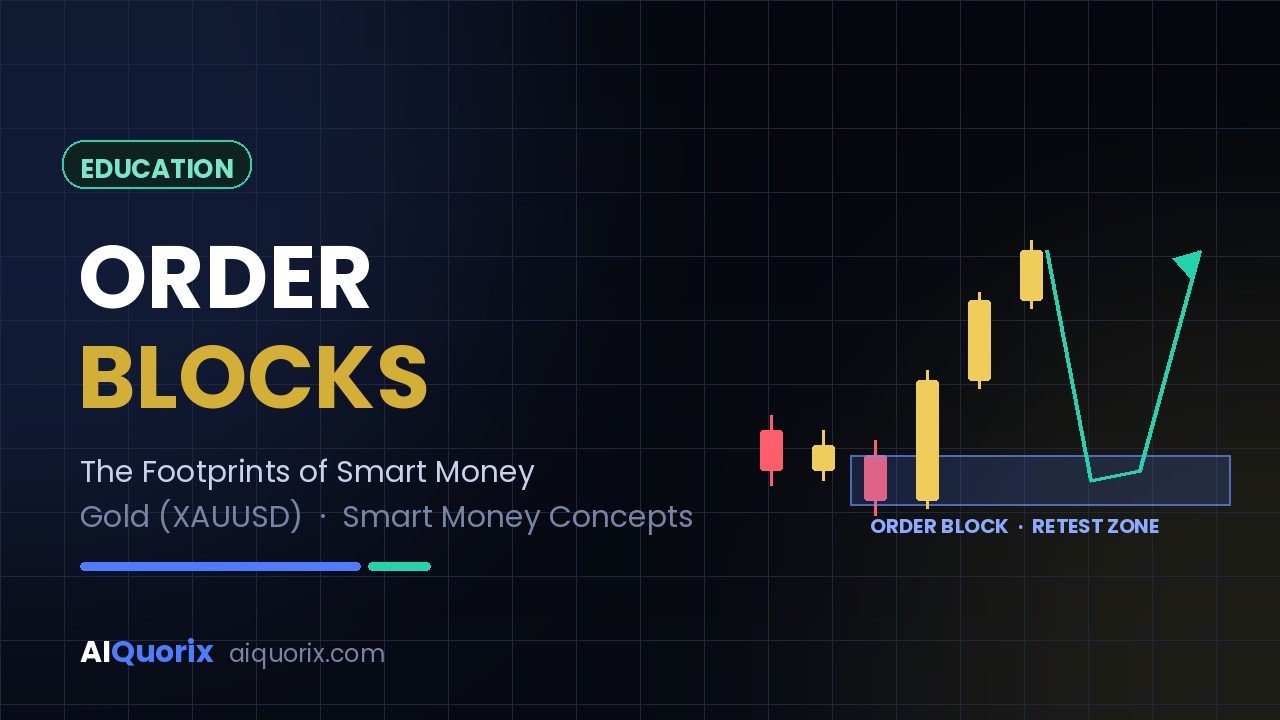
That quiet accumulation zone is what we call an order block. It is usually the last opposite-colored candle before a strong, aggressive move.
- Before a strong move up, you will often see one final bearish candle. That candle is a bullish order block.
- Before a strong move down, you will often see one final bullish candle. That candle is a bearish order block.
Think of it as the springboard the big players jumped from. The move did not start by accident — it started where their orders were sitting.
Why price comes back to these zones
Here is the part that makes order blocks tradeable. Institutions almost never get their full position filled in one go. Some of their orders are left behind, unfilled, sitting in that same zone.
So what happens next? Price runs away, cools off, and very often returns to the order block. When it does, those leftover orders get filled — and the zone acts like a launchpad for the second leg of the move. That return visit is called a retest, and it is one of the highest-quality entries in Smart Money Concepts trading.
Retail traders chase the breakout. Smart money waits for price to come back to where the move was born.
How to spot an order block on Gold
Gold (XAUUSD) is an ideal market for this because it is heavily traded by institutions and moves with strong momentum. Open the 15-minute chart and look for this sequence:
- A clear, aggressive move — a candle or series of candles with large bodies and small wicks.
- The last opposite candle right before that move started. Mark its high and low. That range is your order block.
- A break of structure — the move should take out a recent high or low, confirming that real force entered the market.
Now you wait. If price returns to your marked zone and holds there, that is your area of interest. A stop loss goes below the block (for buys) or above it (for sells), which gives you a defined, logical risk — not a random number of pips.
What makes an order block stronger
Not every last candle is worth trading. The best order blocks share a few traits:
- The move away from the block was fast and impulsive, not slow and choppy.
- The move broke market structure — it took out a previous swing high or low.
- The zone lines up with a fair value gap or a liquidity level nearby.
- Price has not already returned to the zone multiple times. Fresh zones work best; every retest weakens the block.
Common mistakes to avoid
The biggest mistake is marking every candle as an order block and calling it a strategy. If everything is a zone, nothing is. The second mistake is entering the moment price touches the zone without any confirmation, and the third is moving your stop loss deeper when price goes against you. The whole point of an order block is that it gives you a logical invalidation level — respect it.
The honest problem with trading order blocks manually
Here is what nobody tells you. Trading order blocks well requires you to be there. Gold does not care about your time zone. The cleanest retest of the week might happen at 3 a.m. while you sleep, or during your job, or the one evening you decided to rest. You can do everything right and still miss the trade — or worse, catch it late and enter at a bad price.
And when you are watching the chart for hours waiting for a retest, boredom starts making decisions for you. That is how a good plan turns into a revenge trade.
How Raees Concept EA handles this for you
This exact problem is why we built Raees Concept EA. It runs on the Gold 15-minute chart and does the full process automatically, around the clock:
- Detects fresh bullish and bearish order blocks as they form.
- Waits for a confirmed market structure shift or break of structure before trusting the zone.
- Enters on the retest, with the stop loss placed logically beyond the block.
- Targets the next liquidity zone for take profit, and manages the trade with a trailing stop.
No screen time, no emotions, no missed 3 a.m. setups. The strategy you just learned in this post is the same logic the EA executes — it just never sleeps and never gets impatient.
If you want to see it in action, start with a demo account, run it on XAUUSD M15, and watch how it marks and trades these zones. Our full setup guide walks you through the installation in about ten minutes.
Trading involves substantial risk. Only trade with capital you can afford to lose. Past performance does not guarantee future results.