Fair Value Gaps Explained: Why Price Always Comes Back
A fair value gap is the market's unfinished business. Here's what an FVG actually is, how to find one on the Gold chart, and why price fills these gaps with almost eerie consistency.
Pull up any Gold chart and scroll back a few days. Somewhere in there you will find a candle so aggressive that it left a hole behind it — a stretch of price where almost no trading happened. Days later, price crawled all the way back to that exact spot, touched it, and reversed.
That hole has a name. It is called a fair value gap, or FVG, and once you learn to see them you will find them everywhere.
What is a fair value gap?
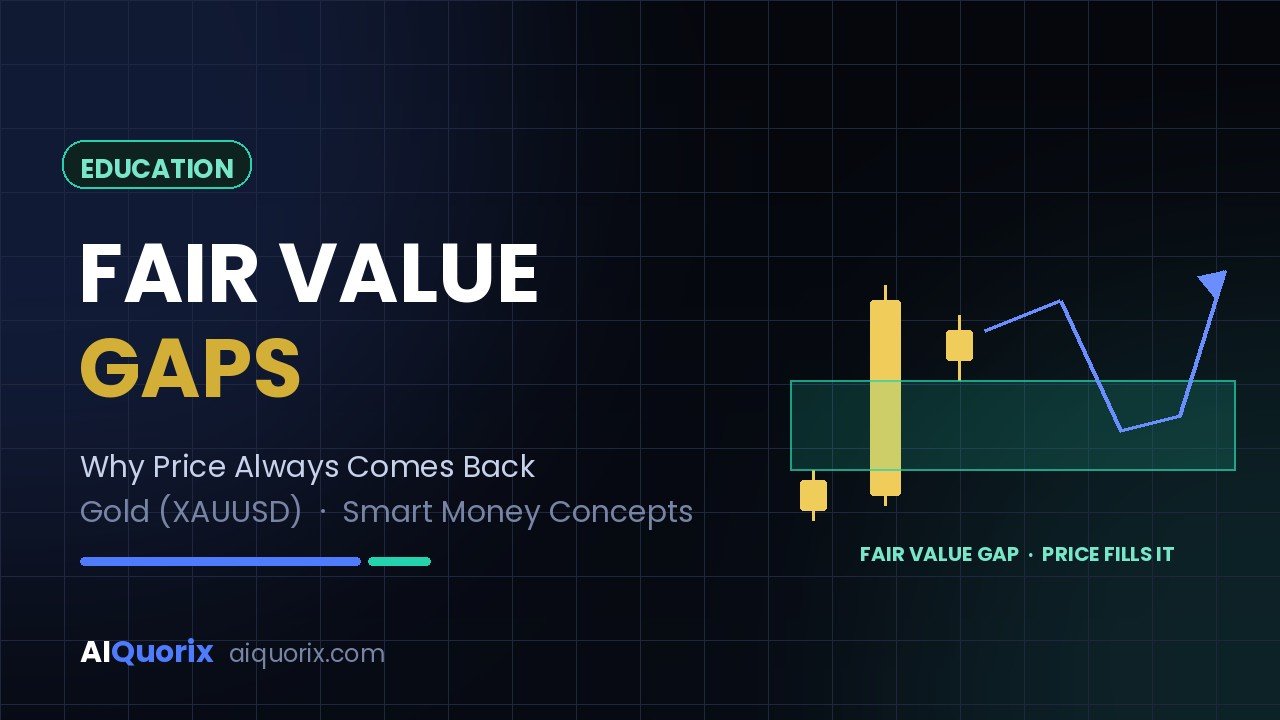
A fair value gap is a three-candle pattern. It forms when the middle candle is so strong that the first candle's wick and the third candle's wick never overlap. The space between them is the gap — a zone the market skipped over in its rush.
Why does it matter? Because markets hate skipping things. In a healthy move, buyers and sellers agree on prices step by step. But when price explodes through a level in one candle, there was no real two-way trading there. No agreement. The move was one-sided, which means one side got left out.
Traders call this an imbalance, and the market has a well-known habit of returning to imbalances to trade there properly before continuing. That return trip is what we mean when we say the gap gets filled.
How to spot an FVG on the Gold chart
You need exactly three candles. On the 15-minute XAUUSD chart, look for this:
- Bullish FVG: the middle candle is strongly bullish, and there is open space between the high of candle one and the low of candle three. That space is your gap.
- Bearish FVG: the middle candle is strongly bearish, and the gap sits between the low of candle one and the high of candle three.
Mark the gap as a zone on your chart. That's it. No indicator needed — this is pure price action, and Gold prints these constantly because of how violently it moves during London and New York sessions.
Why price comes back to fill the gap
Think about who is trapped when price gaps away. Traders who missed the move want a second chance to get in at a fair price. Institutions who only got part of their position filled want to complete it. Anyone caught on the wrong side wants out at a better level. All of that interest sits inside the gap, waiting.
So when price drifts back into the zone, orders start firing. Very often the gap acts like a magnet on the way in and a springboard on the way out — price fills the imbalance and then resumes the original direction.
The first move shows intent. The return to the gap is your invitation.
Does every gap get filled? No, and anyone who tells you otherwise is selling something. Strong trends can leave gaps unfilled for days or ignore them completely. That is exactly why an FVG alone is not a strategy — it needs context.
What separates a tradeable FVG from noise
After watching thousands of these on Gold, a few filters make all the difference:
- The gap should form during a real move, not in quiet sideways chop.
- It works best when it lines up with an order block or a recent break of structure — if you read our order blocks guide, you already know why these zones attract price.
- Fresh gaps beat old ones. The first return to a gap is the one that matters.
- Direction matters. In an uptrend, trust bullish FVGs below price. Fading a strong trend because of one gap is how accounts get hurt.
When an FVG and an order block overlap in the same area, you have one of the cleanest setups Smart Money Concepts has to offer. Price pulled into that pocket, with structure behind it, is the kind of entry institutional traders build careers on.
The catch nobody talks about
Here is the honest part. FVGs form at all hours, and Gold does not wait for you. The best gap of the week might get filled at 4 a.m. your time. You could mark five perfect zones tonight and sleep through every single retest.
Watching charts around the clock is not a strategy — it is a burnout plan.